✨ Hiring! ✨
If you are interested in joining the team as a research assistant or postdoc, please, email me (laura.symul [at] uclouvain.be) your CVs and briefly describes your interests and motivations.
I also regularly recruit master students (“jobistes”) to help and assist with research, software development, teaching-related tasks, or research coordination. Feel free to reach out if you are interested.
In addition, each year, ISBA opens a few positions for doctoral students to assist with teaching and research. Contact us for more information, we are looking forward to meeting you.
Hello and Welcome!
I am an Assistant Professor in Applied Biostatistics at ISBA (Institute for Statistics, Biostatistics, and Actuarial Sciences) at UCLouvain (Belgium) since September 2023. Before that, I was a postdoc at Stanford University (Department of Statistics), working with Prof. Holmes.
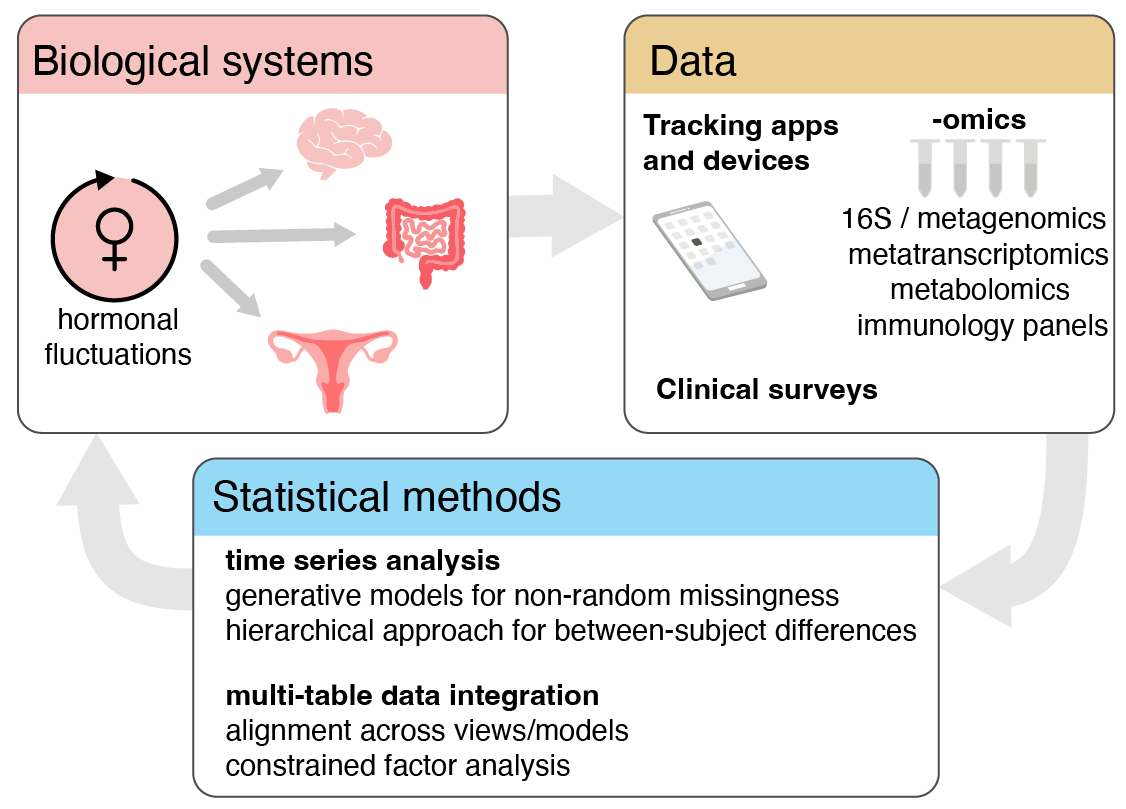
Currently, my research focuses on developing and applying statistical methods to address questions in women’s health, with a particular interest in the vaginal microbiota and menstrual health. This includes research on identifying drivers of spontaneous or induced changes in vaginal microbiota communities and their ecosystem, or on developing methods to infer reproductive events from self-reported signs and symptoms.
Specifically, I am interested in multi-omics integration models to uncover shared and independent latent structures that may evolve over time (i.e., applied to longitudinal datasets) and predict health outcomes, and in models that can explain microbiota community dynamics by inferring bacteria-bacteria interactions and perturbations’ effects. I also provide guidance to clinical collaborators in designing studies, especially regarding the dispatch of samples and aliquots to avoid or minimize confounding with a series of nuisance factors (e.g., shipping, processing, or measurement batches), the design of appropriate positive and negative controls and replication strategies, and the optimal sampling frequency in longitudinal studies. I work with multi-domain clinical data (integrating clinical survey data, microbiologic measurements, and various -omics datasets), self-reported digital records (e.g., data from mobile phone apps), and publicly available datasets. These research activities have been supported by several private and public stakeholders (see my CV)
I obtained my PhD in computational biology from the École Polytechnique Fédérale de Lausanne (EPFL) in Switzerland, where I worked on the molecular regulation of the circadian clock. In particular, I was interested in the regulation of rhythmic gene expression and protein translation, combining analyses of -omics data with mathematical models of regulatory dynamics to infer quantities that are otherwise not measurable.
I have also specialized in data and information visualization and, during my industry experience, have helped companies and organizations to make data-driven decisions.